WhatsApp-Based Training for Employees: Complete 2026 Guide
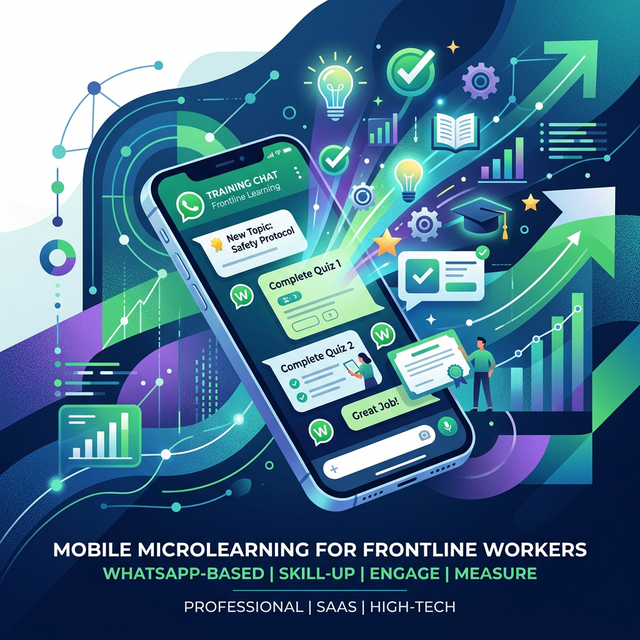
WhatsApp has 2.7 billion monthly active users worldwide. In India alone, over 500 million people use it daily. Your factory workers use it. Your retail associates use it. Your delivery drivers use it. Your security guards use it.
Yet when it comes to employee training, most companies still insist on platforms their frontline workers never open — LMS portals that require logins, apps that need downloads, and courses designed for people sitting at desks.
WhatsApp-based training flips this entirely. Instead of hoping workers will come to the training, you send the training to where workers already are — their WhatsApp inbox. No app downloads. No login credentials. No computer required.
This guide covers everything you need to know about delivering employee training through WhatsApp in 2026: who it works for, how it works, what it looks like across industries, and how to launch your first WhatsApp training program in under a week.
Why WhatsApp Is the Most Underrated Training Channel
The numbers tell the story:
- 2.7 billion monthly active WhatsApp users globally (as reported by Meta)
- 98% message open rate on WhatsApp, compared to 20–30% for email and under 50% for most training apps
- 500+ million WhatsApp users in India — making it the largest market for the platform
- In most emerging markets, WhatsApp is not just a messaging app — it's the primary internet experience for millions of workers
For frontline and deskless workers specifically, WhatsApp has an advantage no other training channel can match: it's already installed, already used daily, and requires zero behavior change. Workers don't need to learn a new tool. They just open the same app they use to message family, check group chats, and coordinate with coworkers.
Compare that with a dedicated training app: you need workers to find it in the app store, download it (often on phones with limited storage), create an account, remember their password, and then actually open it regularly. At each of these steps, you lose a chunk of your workforce.
Who Benefits Most from WhatsApp-Based Training
WhatsApp-based training is not for every team. It's specifically designed for workers who meet most of these criteria:
- Frontline workers who don't sit at desks: factory floor operators, retail store associates, delivery drivers, security personnel, housekeeping staff, field sales teams
- Distributed workforces spread across multiple locations: multi-plant manufacturing, multi-city retail, facility management across dozens of client sites
- Workers without corporate devices: people using personal smartphones, often budget Android phones
- Workers without corporate email: which means they can't receive LMS invitations, password reset links, or Outlook calendar reminders
- Multilingual teams: where English isn't the working language on the ground, even if it's the corporate language
- High-turnover workforces: where onboarding needs to happen fast and continuously, not in quarterly batches
Industries where WhatsApp-based training delivers the strongest results: manufacturing, retail, logistics, facility management, BFSI (field agents and branch staff), hospitality, and security services.
How WhatsApp-Based Training Works
Here's the step-by-step flow of how platforms like Leap10x deliver training through WhatsApp:
Step 1: Upload your existing content. Take your SOPs, safety manuals, product guides, or compliance documents — usually PDFs or presentations — and upload them to the platform. You don't need to start from scratch.
Step 2: AI converts content into micro-modules. The platform's AI breaks your 50-page safety manual into 8–12 micro-lessons of 3–5 minutes each. Each module includes visuals, key points, and a short quiz. Content is generated in the language you need — Hindi, Tamil, Telugu, Marathi, or any of 15+ languages.
Step 3: Assign training to workers. Upload your worker list (phone numbers are enough — no email needed). Assign specific modules to specific groups: safety training for plant A, product knowledge for retail team B, compliance refresher for all new hires.
Step 4: Workers receive training on WhatsApp. Each worker gets a WhatsApp message with their training module. They tap, read/watch the micro-lesson, answer the quiz questions, and get instant feedback. The entire experience happens inside WhatsApp — no browser redirect, no app switch.
Step 5: Track completion and performance. The admin dashboard shows real-time completion rates, quiz scores, and certification status. You know exactly who has completed training, who hasn't, and who needs a follow-up nudge. All data is exportable for compliance audits.
Step 6: Automated reminders and follow-ups. Workers who haven't completed their modules get gentle WhatsApp reminders. No need for managers to chase people manually.
Use Cases by Industry
Manufacturing: Safety and compliance training
A Tata Electronics plant uses WhatsApp-based training to deliver PPE compliance modules, machine operation SOPs, and fire safety refreshers to 5,000+ workers across multiple plants. Training is delivered in Hindi and local languages at shift change times. Completion rates exceed what the previous LMS achieved.
Key topics delivered via WhatsApp in manufacturing: PPE usage, chemical handling (SDS/MSDS), lockout-tagout (LOTO) procedures, fire safety, first aid basics, quality control checks, 5S workplace organization.
Retail: Product knowledge and customer service
Retail chains use WhatsApp training to push new product information before every launch. Store associates receive a 4-minute product overview with images and a quick quiz — all on WhatsApp before the store opens. This replaces the old model of regional trainers traveling to each store.
Key topics: new product launches, seasonal collection briefings, customer service scripts, POSH compliance, visual merchandising standards, loss prevention.
Logistics: Driver safety and route compliance
Logistics companies send daily micro-training to delivery drivers — vehicle inspection checklists, route safety reminders, customer handling protocols. Drivers complete training during loading wait times, without leaving their truck cab.
Key topics: pre-trip vehicle inspection, defensive driving, load securing, delivery protocol, customer interaction, fuel efficiency.
BFSI: Regulatory compliance for field agents
Banks and insurance companies use WhatsApp training for field agents who sell at branches, customer homes, and local markets. Compliance training on KYC norms, product disclosure requirements, and anti-fraud procedures reaches agents who never log into the corporate intranet.
Key topics: KYC compliance, product suitability, customer disclosure requirements, anti-money laundering basics, data privacy, IRDAI/SEBI regulatory updates.
See how Leap10x works for your industry →
WhatsApp Training vs Traditional LMS: A Comparison
| Factor | Traditional LMS | WhatsApp-Based Training |
|---|---|---|
| Access method | Login with credentials on browser/app | Open WhatsApp (already installed) |
| Device required | Laptop/desktop or dedicated app | Any smartphone with WhatsApp |
| Content length | 30–60 minute courses | 3–5 minute micro-modules |
| Language support | Primarily English | 15+ local languages |
| Internet requirement | Continuous broadband | Works on basic mobile data |
| Completion rates (frontline) | Typically below 20% | Significantly higher due to channel familiarity |
| Time to deploy | Weeks to months | Hours to days |
| Worker behavior change needed | High (new tool, new habit) | Minimal (same app they already use) |
| Cost of rollout | License + devices + IT support | Platform subscription only |
| Offline availability | Varies | WhatsApp messages persist offline |
Implementation Checklist: Launch WhatsApp Training in 7 Days
Day 1–2: Prepare your content
- Gather your top-priority training documents (safety SOPs, compliance manuals, product guides)
- Identify which 3–5 modules you want to pilot first
- Decide on target languages
Day 3: Set up the platform
- Upload documents to Leap10x
- AI generates micro-modules — review and approve
- Upload your worker phone number list
Day 4–5: Pilot with a small group
- Send training to 50–100 workers as a test
- Monitor completion rates and quiz scores
- Collect feedback from workers and their managers
Day 6: Adjust and expand
- Fix any content issues flagged in the pilot
- Add more modules or languages as needed
- Expand to the full target group
Day 7: Full launch
- Deploy to your complete workforce
- Set up automated reminders for non-completers
- Brief managers on how to view their team's progress
Start your free WhatsApp training pilot →
Start Your Free WhatsApp Training Pilot
WhatsApp-based training isn't theoretical. Companies like Siemens and Tata Electronics already use it to train thousands of frontline workers across manufacturing, retail, and logistics operations.
You can start a pilot with your existing content, in your workers' language, and see completion rates within the first week.
FAQs
- Q: What is WhatsApp-based training?
A: WhatsApp-based training is a method of delivering employee training directly through WhatsApp messages. Workers receive micro-learning modules, complete quizzes, and get certified — all within the WhatsApp app they already use daily. It eliminates the need for app downloads, login credentials, or computers. Platforms like Leap10x use AI to convert existing documents into WhatsApp-ready training modules in 15+ languages. - Q: Can you use WhatsApp as an LMS?
A: WhatsApp alone is not an LMS. But platforms like Leap10x use WhatsApp as the delivery channel while providing a full backend with content creation, learner management, quiz scoring, completion tracking, and compliance reporting. Workers interact through WhatsApp; admins manage everything through a dashboard. It provides LMS functionality without requiring workers to access an LMS portal. - Q: How effective is training delivered via WhatsApp?
A: WhatsApp messages have a 98% open rate, compared to 20–30% for email. Because workers already use WhatsApp daily, there is no adoption barrier. Companies using WhatsApp-based training through platforms like Leap10x report significantly higher completion rates compared to traditional LMS-based training for frontline workers, where completion often falls below 20%. - Q: Is WhatsApp-based training secure for corporate use?
A: WhatsApp uses end-to-end encryption for all messages. Platforms like Leap10x add additional security layers: worker data is stored separately from training content, access is controlled through the admin dashboard, and all data handling follows standard enterprise privacy practices. Training content is delivered as interactive messages, not downloadable files that could be redistributed. - Q: How much does WhatsApp-based training cost?
A: Costs vary by platform and scale. Leap10x offers pricing designed for large frontline workforces in emerging markets, where per-user costs need to stay low. There's no hardware cost (workers use their existing phones) and no IT deployment cost (no apps to install or configure). See pricing details → - Q: Can WhatsApp training work for compliance and safety certification?
A: Yes. Platforms like Leap10x track every module completion, quiz score, and certification. This data is exportable and audit-ready. For industries with regulatory requirements — manufacturing safety (Factories Act), BFSI compliance (KYC/AML), food safety (FSSAI) — WhatsApp-delivered training with tracked completion provides documentation that satisfies audit requirements.