Onboard Insurance Agents 10x Faster with Microlearning | Leap10x
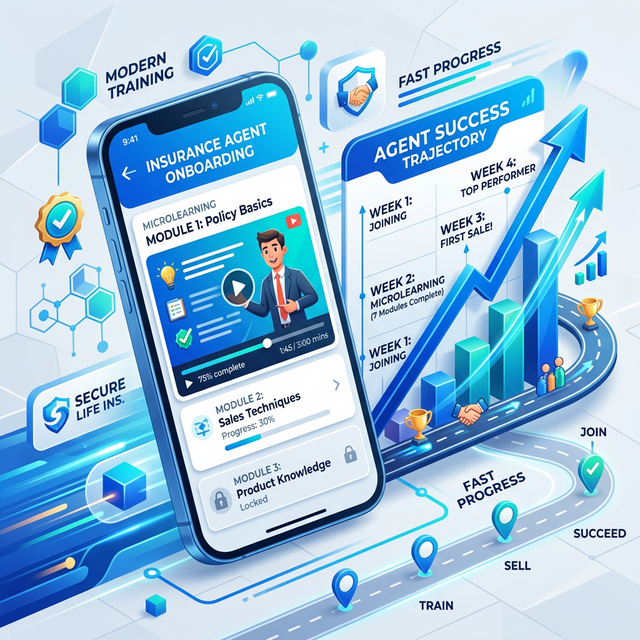
Insurance companies in India — LIC, HDFC Life, ICICI Prudential, SBI Life, Bajaj Allianz, and hundreds of smaller players — onboard tens of thousands of agents every year. The traditional process takes 2–4 weeks of classroom training, costs ₹15K–25K per agent, and produces a depressing result: agents forget most of it within 30 days, and over 50% leave within the first year.
That's a staggering waste of time and money. If you onboard 10,000 agents a year at ₹20K each, you're spending ₹20 crore annually on training — and half those agents won't be around to use it.
This post lays out a different approach: microlearning-based onboarding delivered via WhatsApp. It cuts ramp-up time from weeks to days, reaches agents in Tier 2/3 cities without travel, and gives managers real-time visibility into who's ready and who's not.
The Insurance Agent Onboarding Crisis
The numbers tell the story:
- ₹15K–25K per agent for classroom onboarding (travel, accommodation, trainer costs, venue, materials).
- 2–4 weeks before a new agent is considered "trained" and cleared to sell.
- 80% knowledge loss within 30 days of classroom training — a well-documented phenomenon called the forgetting curve.
- 50%+ first-year attrition among insurance agents. Half the people you train won't be selling your products by next year.
- 10,000–100,000 agents onboarded annually by large insurers. The scale makes every inefficiency expensive.
For the VP of Agency Training or Head of Channel, this creates a Sisyphean loop: train, lose, train again, lose again. The agents who stay are often undertrained because the onboarding was a one-time information dump, not a structured learning process.
Why Traditional Onboarding Fails Insurance Agents
The standard onboarding model has specific failure points for insurance agents:
Information overload in week one. A new agent is expected to absorb: company history, product portfolio (8–15 products), IRDAI regulations, sales process, CRM tools, claim procedures, objection handling, and compliance norms — all in 5–10 days. The brain doesn't work that way.
English-only materials. Most onboarding decks are in English. Most insurance agents in Tier 2/3 cities are more comfortable in Hindi, Tamil, Telugu, Marathi, or their regional language. Content they can't fully understand is content they can't apply.
No reinforcement after classroom. Day 10, the classroom session ends. Day 11, the agent is in the field. There's no structured follow-up, no spaced repetition, no daily reinforcement of what they learned. Within a month, they're selling based on what they vaguely remember — which leads to mis-selling complaints and regulatory risk.
Agents in Tier 2/3 cities can't attend centralized training. Not every new agent can travel to a regional office for a week. Some insurers delay onboarding until they have a "batch" of 30+ agents — which means new agents sit idle for weeks waiting for training.
Platforms like Disprz and Enthral require app downloads and logins. Even when insurers invest in digital onboarding via LMS platforms, field agents often don't complete the modules. The friction of downloading an app, creating credentials, and navigating a dashboard is too high for agents who live on WhatsApp.
The Microlearning Onboarding Model: 4 Weeks of Content, Delivered in Daily Bites
Instead of dumping everything into 5 classroom days, the microlearning model spaces onboarding over 4 weeks with daily WhatsApp modules:
Week 1: Company and Product Basics
- Day 1: Welcome message + company overview (3-minute video in agent's language)
- Day 2: Product portfolio overview — what the company sells and who buys it
- Day 3: Flagship product deep-dive — features, benefits, target customer
- Day 4: Second key product deep-dive
- Day 5: Quiz — 10 questions covering Week 1 topics
Week 2: Sales Scripts and Objection Handling
- Day 6: The first customer conversation — opening script
- Day 7: Needs identification — questions to ask before recommending a product
- Day 8: Top 5 objections and how to handle them ("I already have insurance," "It's too expensive," "I'll think about it")
- Day 9: Closing the conversation — when and how to ask for the sale
- Day 10: Role-play scenario quiz — "Customer says X, what do you say?"
Week 3: Compliance and Ethics
- Day 11: IRDAI basics — what every insurance agent must know
- Day 12: Product disclosure requirements — what you must tell the customer
- Day 13: What you can't do — mis-selling, misrepresentation, pressure tactics
- Day 14: KYC process for new policies
- Day 15: Compliance quiz with certificate
Week 4: Advanced Product Knowledge and Cross-Sell
- Day 16: Understanding riders and add-ons
- Day 17: Comparing your products to competitor offerings (factually, not dishonestly)
- Day 18: Cross-selling opportunities — term + health, savings + pension
- Day 19: Claim process — what happens when a customer files a claim
- Day 20: Final assessment — comprehensive quiz covering all 4 weeks
Each day's content takes 5–10 minutes. Agents complete it between customer visits. No classroom, no travel, no app download.
How WhatsApp Delivery Changes the Game
Why WhatsApp specifically — and not an app, email, or LMS?
- Zero friction. Agent doesn't download anything, doesn't create an account, doesn't learn a new interface. They open WhatsApp — something they do 50+ times a day — and the training is there.
- Content pushed daily in the agent's language. A new agent in Kochi gets onboarding in Malayalam. An agent in Lucknow gets it in Hindi. Same content, same quality, different language.
- Quiz-gated progression. Agents can't skip ahead. They must complete each day's quiz before receiving the next day's module. This ensures actual learning, not just clicking through.
- Manager visibility into completion. The training manager sees a real-time dashboard: which agents completed today's module, who's falling behind, who needs a phone call.
- No travel required. An agent in Dharwad gets the same onboarding quality as an agent in Mumbai. Geography stops being a barrier.
5 Content Modules Every Insurance Onboarding Program Needs
Whether you build this yourself or use Leap10x, these five modules are non-negotiable for insurance agent onboarding:
- Product portfolio overview. Not just features — who buys each product and why. Agents need to match products to customer needs, not recite brochure specs.
- Claim process walkthrough. Agents who understand the claim process sell more confidently. They can answer "what happens if I need to claim?" — the question every customer asks.
- IRDAI compliance essentials. What agents must disclose, what they can't promise, how to document conversations. This protects the agent, the customer, and the insurer.
- Needs-based selling approach. Move agents away from product-push selling toward understanding customer needs first. "Tell me about your family" before "Let me tell you about our term plan."
- Digital tools and app training. Policy issuance apps, CRM, payment links, e-KYC. Agents need to know the tools before they're in front of a customer trying to figure out the interface.
Results Framework: What to Measure
Track these metrics to evaluate microlearning onboarding vs. your current approach:
- Time to first sale. How quickly do new agents close their first policy? Target: reduce from 30+ days to under 14 days.
- Certification pass rate. What percentage of agents pass the IRDAI compliance assessment on their first attempt?
- First-year retention. Are agents who complete structured microlearning onboarding more likely to stay beyond 12 months?
- Onboarding cost per agent. Total cost including content delivery, tracking, and assessment — compared to classroom cost of ₹15K–25K.
- Manager intervention rate. How many agents need additional phone or in-person coaching beyond the WhatsApp modules?
See the Insurance Onboarding Solution
Leap10x converts your existing product documents, compliance materials, and sales training content into WhatsApp-ready micro-modules using AI. New agents receive daily training on their phone in their language, complete quizzes to verify understanding, and earn certificates for compliance tracking.
The result: agents onboarded in days instead of weeks, at a fraction of the cost, with better retention of what they learned.
FAQs
- Q: How long does it take to onboard a new insurance agent with microlearning?
A: With microlearning delivered via WhatsApp, structured onboarding content is spread across 4 weeks in daily 5–10 minute modules. Agents begin receiving training content on day one — no waiting for classroom batches. Core product knowledge and compliance essentials are covered in the first two weeks, with advanced topics in weeks three and four. - Q: How much does insurance agent onboarding cost with WhatsApp microlearning vs. classroom?
A: Traditional classroom onboarding costs ₹15K–25K per agent including travel, accommodation, trainer fees, and materials. WhatsApp-based microlearning significantly reduces this by eliminating travel, venue, and printed material costs while reaching agents in any city. - Q: Can microlearning onboarding replace classroom training entirely for insurance agents?
A: For product knowledge, compliance, and sales scripting, microlearning via WhatsApp can replace most classroom content. Some insurers still use a 1–2 day in-person session for company culture, team bonding, and hands-on tool training — but the bulk of knowledge transfer happens more effectively through spaced, daily micro-modules. - Q: What content should be included in an insurance agent onboarding program?
A: Five essential modules: product portfolio overview (matching products to customer needs), claim process walkthrough, IRDAI compliance essentials (disclosure requirements, ethical selling), needs-based selling approach (scripts and objection handling), and digital tool training (policy apps, CRM, e-KYC). - Q: Do insurance agents in Tier 2/3 cities complete WhatsApp-based onboarding?
A: Yes — WhatsApp delivery significantly improves completion for Tier 2/3 agents because the content arrives in their preferred language on an app they already use daily. There's no travel requirement, no app download, and no login. Agents complete modules between customer visits at their own pace.