Microlearning vs Traditional Training: The ROI Data (2026)
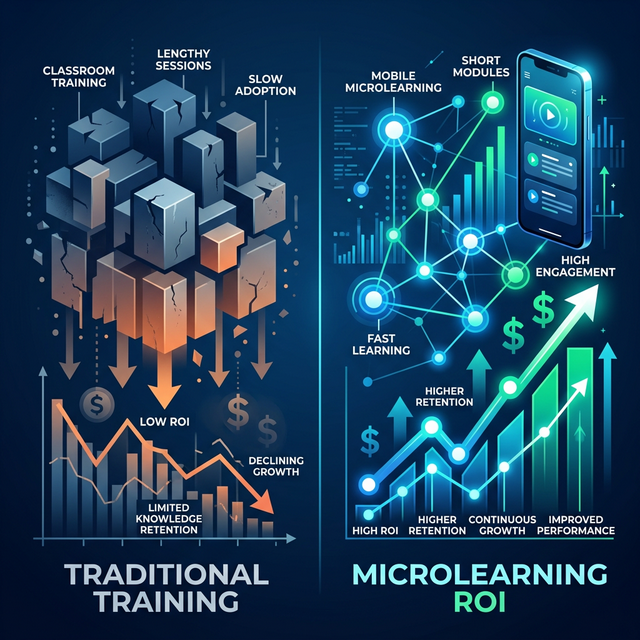
Your CFO doesn't care about "learning culture." They care about whether the money you spend on training produces measurable results. And right now, the data says most of it doesn't.
Research based on Ebbinghaus's forgetting curve shows that people forget approximately 70% of new information within 24 hours and up to 90% within a month if it isn't reinforced. That means the bulk of your traditional training investment — the instructor travel, the venue bookings, the two-day workshops — evaporates within weeks.
Microlearning offers a fundamentally different ROI equation. Not because it's trendy, but because it changes the mechanics of how training is delivered, consumed, and retained. This article presents the data comparing microlearning vs traditional training across the metrics your finance team actually cares about: cost, speed, retention, and completion.
The Forgetting Curve: Why 80% of Traditional Training Is Wasted
Hermann Ebbinghaus's research on memory, first conducted in the 1880s and validated repeatedly since, established the "forgetting curve" — the rate at which newly learned information decays without reinforcement.
The practical implications for corporate training are significant:
- Within 1 hour of a training session, learners have forgotten roughly 50% of the content
- Within 24 hours, roughly 70% is forgotten
- Within 30 days, up to 90% of the material is gone — unless it was reinforced
This isn't a commentary on your training quality. It's how human memory works. A beautifully designed 4-hour workshop on safety procedures will produce the same forgetting curve as a mediocre one — because the problem is the format, not the content.
Traditional training delivers information in large, infrequent doses. Microlearning delivers it in small, frequent doses with built-in reinforcement. That single structural change dramatically alters what learners retain over time.
Microlearning by the Numbers
Here's what the research and industry data show when organizations switch from traditional training to microlearning:
Knowledge retention: up to 50% higher. The Journal of Applied Psychology found that learning in smaller segments with spaced repetition can improve long-term retention by up to 50% compared to single-session instruction. The mechanism is straightforward: shorter content is easier to focus on, and repeated exposure over days and weeks reinforces memory.
Learner engagement: up to 50% higher. Studies by organizations like the Association for Talent Development (ATD) report that microlearning increases learner engagement metrics — including completion rates, voluntary participation, and satisfaction scores — by roughly 50% compared to traditional e-learning courses.
Content creation speed: up to 300% faster. Traditional instructional design for a 1-hour e-learning course can take 40–100 hours. A microlearning module covering the same topic in 3–5 minute segments can be created in a fraction of that time. With AI-powered tools like Leap10x, which converts existing PDFs and documents into micro-modules, creation speed improves even further.
Training cost reduction: up to 50%. By eliminating instructor travel, venue costs, printed materials, and worker downtime, microlearning can cut direct training costs by half. For frontline workforces spread across multiple sites, the logistics savings alone are substantial — no more flying trainers to 15 plants or pulling workers off shifts for classroom sessions.
Completion rates: significantly higher for frontline workers. Traditional LMS-based training for frontline workers typically sees completion rates below 20–30%, primarily because workers don't have easy access to the platform. WhatsApp-based microlearning, where training goes directly to the worker's phone, changes this equation fundamentally.
Head-to-Head Comparison: Traditional Training vs Microlearning
| Dimension | Traditional Training | Microlearning |
|---|---|---|
| Session length | 1–8 hours | 3–5 minutes |
| Delivery method | Classroom, webinar, or LMS | Mobile device (WhatsApp, app, or SMS) |
| Content creation time | 40–100+ hours per hour of content | 5–15 hours per equivalent content |
| Knowledge retention at 30 days | ~10% without reinforcement | Up to 50% higher with spaced repetition |
| Learner engagement | Declines after 15–20 minutes | Sustained through short, focused modules |
| Completion rate (frontline) | Below 20–30% for LMS-based | Significantly higher on familiar channels |
| Cost per learner | Higher (venue, travel, materials, time off) | Lower (digital delivery, no logistics) |
| Language adaptation | Expensive manual translation | AI-powered multi-language generation |
| Update speed | Weeks to update and redistribute | Hours to edit and push to workers |
| Analytics | Post-session surveys, basic LMS data | Real-time completion, quiz scores, gap analysis |
| Accessibility for deskless workers | Low (requires computer or scheduled session) | High (personal phone, anytime) |
When Traditional Training Still Makes Sense
Microlearning isn't a replacement for everything. There are training scenarios where longer, hands-on formats remain more effective:
- Hands-on skills training: Operating complex machinery, performing medical procedures, or handling hazardous materials requires supervised, in-person practice. Microlearning can reinforce the theory, but the physical skill needs a physical environment.
- Leadership and management development: Building leadership capabilities involves coaching, reflection, and group discussion that benefit from longer, immersive formats.
- Complex new-hire orientation: A new employee's first day — understanding company culture, meeting teams, touring facilities — benefits from an in-person or live virtual experience.
- Crisis and emergency response drills: Active fire drills, evacuation procedures, and emergency response require physical practice, not just knowledge.
The smart approach is hybrid: use traditional formats for what they do best (hands-on practice, immersive experiences) and microlearning for what it does best (knowledge transfer, reinforcement, compliance, updates).
The Hybrid Approach: Microlearning for Reinforcement, ILT for Complex Skills
The highest-performing training programs in 2026 don't choose between microlearning and traditional training. They use each for what it's best at:
- Instructor-led training (ILT) for initial skill teaching, especially hands-on skills, safety drills, and complex procedures that require human supervision
- Microlearning for pre-training preparation, post-training reinforcement, ongoing compliance refreshers, and knowledge checks
- Spaced repetition to combat the forgetting curve — sending brief refresher quizzes at 1 day, 3 days, 7 days, and 30 days after initial training
A practical example: a manufacturing company runs a 4-hour hands-on lockout-tagout (LOTO) training once. Then Leap10x delivers weekly 3-minute microlearning refreshers on specific LOTO steps via WhatsApp for the next 3 months. Workers retain the procedure because they're reminded regularly — without ever being pulled off the floor again.
How Leap10x Customers See These Results in Practice
Companies using Leap10x for frontline training see the microlearning ROI advantage play out across several dimensions:
- Faster content creation: HR teams upload existing safety manuals and SOPs. Leap10x's AI converts them into micro-modules in hours, not weeks. Content that used to take an instructional designer a month to develop is ready in a day.
- Higher completion: Training on WhatsApp reaches workers where they already are. No app to download, no portal to log into. The completion rates reflect the channel difference.
- Real cost savings: No trainer travel to remote plants. No classroom booking. No production time lost to long sessions. Workers complete training during natural work breaks.
- Audit-ready compliance data: Every module completion is tracked with timestamps and quiz scores, exportable for compliance audits. This replaces the old system of collecting sign-off sheets that prove attendance but not understanding.
Companies like Siemens and Tata Electronics use Leap10x to deliver this model across manufacturing operations.
Calculate Your Training ROI with Leap10x
If you're spending money on training that your frontline workers aren't completing, the ROI question isn't whether microlearning costs less. It's how much you're currently wasting.
Book a demo and we'll help you map the actual cost comparison for your specific workforce — number of workers, number of locations, current completion rates, and compliance requirements.
FAQs
- Q: Is microlearning more effective than traditional training?
A: For knowledge retention and completion rates, the data says yes. Research based on the forgetting curve shows that short, spaced learning segments improve long-term retention by up to 50% compared to single-session instruction. However, traditional training remains more effective for hands-on skills, leadership development, and complex new-hire orientation. The most effective approach combines both formats. - Q: What is the ROI of microlearning?
A: Microlearning can reduce training costs by up to 50% (by eliminating venue, travel, and downtime costs), create content up to 300% faster than traditional instructional design, and improve knowledge retention by up to 50%. The ROI is highest for frontline workforces spread across multiple locations, where logistics savings and higher completion rates compound. - Q: How does microlearning improve knowledge retention?
A: Two mechanisms. First, shorter content (3–5 minutes) matches the brain's attention span better than hour-long sessions, so more information is absorbed in the first place. Second, spaced repetition — delivering brief refreshers at increasing intervals — combats the forgetting curve by reinforcing memories before they decay. Together, these produce significantly better long-term retention than single-session training. - Q: Can microlearning replace classroom training completely?
A: For pure knowledge transfer — facts, procedures, compliance rules, product information — yes. For hands-on physical skills, leadership development, and emergency drills that require in-person practice, no. The best approach is hybrid: use classroom or hands-on formats for what they do best, and microlearning for everything else. - Q: How long should a microlearning module be?
A: 3–5 minutes is the sweet spot for frontline workers. Long enough to cover one topic with a quiz. Short enough to complete during a work break. Research suggests engagement drops significantly after 5–6 minutes for mobile learning, and modules under 3 minutes may be too brief to create meaningful learning. See Leap10x pricing →