Compliance Training for Manufacturing Workers: 2026 Guide
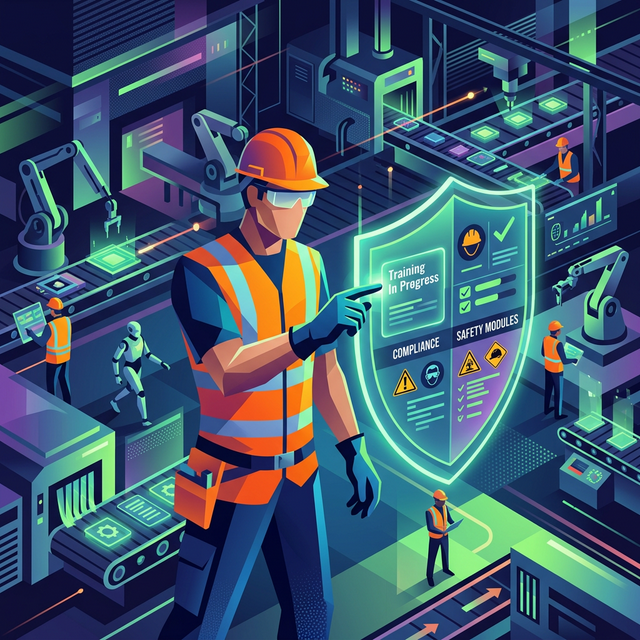
Every year, workplace injuries in Indian manufacturing cost companies crores in medical expenses, production downtime, regulatory penalties, and legal liability. The Factories Act 1948 mandates safety training for all workers. OSHA-equivalent standards apply across international operations. Clients running vendor audits expect documented proof that every worker on the floor has been trained.
Yet most manufacturing companies still deliver compliance training the same way they did 15 years ago: a 4-hour classroom session, conducted in English, for workers who speak Tamil or Hindi, on a day when pulling people off the line disrupts production targets.
The result: training that exists on paper but not in workers' heads. Sign-off sheets that prove attendance but not understanding. And safety incidents that keep happening because the gap between "trained" and "competent" was never closed.
This guide is for the EHS manager or plant HR head who needs compliance training that actually works on the factory floor — in the worker's language, on their phone, without stopping the production line.
The Compliance Training Gap on the Factory Floor
The gap between what compliance training should achieve and what it actually achieves in most manufacturing plants is significant:
- Training happens once a year, risk happens every day. Annual compliance sessions create a spike of awareness that fades within weeks. Workers face safety risks in every shift, but their training is a distant memory by month three.
- Language mismatch: In a plant with workers from Uttar Pradesh, Tamil Nadu, Andhra Pradesh, and Bihar, delivering safety training in English guarantees that most workers will not fully comprehend the material. Comprehension is not optional for safety training — it's the entire point.
- Contractors and temp workers are undertrained: Many manufacturing plants rely on contract workers who may cycle through every few months. These workers often receive minimal training — if any — despite facing the same hazards as permanent staff.
- Documentation doesn't equal competence: Most compliance audits check whether training was "delivered." But a sign-off sheet from a classroom session doesn't tell you whether the worker can identify the correct fire extinguisher for an electrical fire or describe the lockout-tagout procedure for their specific machine.
- Training competes with production targets: Pulling 50 workers off the line for a 4-hour session is a direct hit to that shift's output. Supervisors resist it. Managers delay it. Workers sit through it thinking about their production quota.
Challenges Unique to Manufacturing Compliance Training
Manufacturing isn't retail or IT. The training challenges are specific to how factories operate:
- Shift schedules: A plant running three shifts can never assemble the entire workforce in one room. Training designed for "9 AM Monday" misses two-thirds of the workers.
- Low digital literacy: Some workers — especially older operators and contract staff — are comfortable using WhatsApp but have never navigated a website or downloaded an app from a store.
- Multilingual workforce: A single plant may have workers speaking 3–5 different languages. Creating separate classroom sessions for each language group is logistically impractical.
- Contractor and temporary workers: High turnover among contract staff means onboarding and safety training is a continuous process, not an annual event. Every month, new workers arrive who need the same safety fundamentals.
- Hands-on environment: Workers interact with machinery, chemicals, and physical hazards. Training needs to be visual and practical, not text-heavy or theoretical.
- Regulatory variety: Different compliance requirements overlap — Factories Act, state-level industrial safety rules, client-specific audit standards (ISO 45001, OSHA-aligned requirements for export-facing plants), and internal EHS policies.
What Effective Manufacturing Compliance Training Looks Like
Training that actually reduces incidents and passes audits has four characteristics:
Short and focused. A 3-minute module on "How to inspect your PPE before each shift" completed by 95% of workers is more effective than a 2-hour general safety session completed by 60% and forgotten by month two. Each module covers one procedure, one hazard, or one compliance requirement.
Visual and practical. Photos of correct vs incorrect PPE usage. Short videos demonstrating the lockout-tagout sequence for a specific machine type. Annotated images showing the location of fire extinguishers and emergency exits. Factory workers learn best from seeing the correct action, not reading about it.
In the worker's language. Safety instructions in a language the worker doesn't fully understand are not safety instructions. AI-powered platforms like Leap10x generate training content in Hindi, Tamil, Telugu, Marathi, Bengali, Kannada, and other languages from a single English source document.
On their phone, during natural breaks. Workers complete a 3-minute module during a tea break, a shift changeover wait, or a loading pause. No classroom scheduling. No production disruption. No supervisor resistance.
Key Compliance Topics to Cover
Every manufacturing plant will have site-specific requirements, but these are the universal compliance training topics that should be covered through regular micro-modules:
- Personal Protective Equipment (PPE): Selection, inspection, correct usage, and maintenance for each job type. Not just "wear your PPE" — but which specific PPE for which task and how to check it's still effective.
- Chemical handling and SDS/MSDS: How to read a Safety Data Sheet. What to do if a chemical spill occurs. Correct storage procedures. This is critical for plants handling paints, solvents, lubricants, or cleaning agents.
- Fire safety: Types of fire extinguishers and when to use each. Evacuation routes. Assembly point locations. How to report a fire. Refreshed quarterly, not annually.
- Machine operation safety: Safe startup and shutdown procedures. Guards and safety interlocks — what they do and why you never bypass them. Emergency stop locations and procedures.
- Lockout-Tagout (LOTO): The step-by-step procedure for isolating energy sources before maintenance or repair. One of the most critical compliance topics and one of the most commonly violated.
- First aid basics: When to apply first aid vs when to call for professional help. Location of first aid kits. Basic wound care, burn treatment, and electric shock response.
- Ergonomics and manual handling: Correct lifting techniques. Recognizing early signs of repetitive strain. Workstation adjustments. Particularly important for assembly line and packaging roles.
- Electrical safety: Identifying exposed wiring, correct use of grounding, wet-area precautions. Especially relevant for maintenance crews.
How to Deliver It: WhatsApp-Based Micro-Modules with Quiz Verification
Here's how manufacturing companies using Leap10x deliver compliance training to factory floor workers:
Step 1: Upload your existing safety documents. Plant safety manuals, SOPs, machine-specific procedures, EHS policies — all uploaded to the platform as PDFs or documents.
Step 2: AI generates micro-modules in local languages. The platform converts your 40-page safety manual into 10–15 micro-modules of 3–5 minutes each. Each module is generated in the languages your workers speak — Hindi for the UP team, Tamil for the TN team, Telugu for the AP team — from a single English source.
Step 3: Assign by role and location. Machine operators get machine safety modules. Chemical handling teams get MSDS training. New contractors get the onboarding safety kit. Training is targeted, not one-size-fits-all.
Step 4: Workers complete on WhatsApp. Each worker receives their module on WhatsApp. They read/watch the content, answer the quiz, and get immediate feedback. The format is familiar — it's the same app they use to message their family.
Step 5: Track and report. The dashboard shows completion rates by plant, shift, department, and individual. Quiz scores identify workers who need additional support. All data is exportable for compliance audits — with timestamps, scores, and completion proof.
Step 6: Spaced reinforcement. Critical safety topics are repeated at intervals — a LOTO refresher every 2 weeks, a PPE check reminder before every shift change. This keeps safety top-of-mind, not a once-a-year event.
Case Study: Training 5,000+ Factory Workers Across Multiple Plants
A major electronics manufacturer with 5,000+ workers across 8 plants in India faced a familiar challenge: compliance training was delivered in English classroom sessions once a year, completion was inconsistent across shifts, and contract workers were largely untrained.
After switching to WhatsApp-based micro-training through Leap10x:
- Training was delivered in Hindi, Tamil, and Telugu to match the workforce
- Workers completed modules during shift changeovers — no production downtime
- New contractors received onboarding safety training on their first day via WhatsApp
- Compliance completion became trackable per individual with quiz verification
- Audit documentation moved from paper sign-off sheets to digital, timestamped records
See the manufacturing training solution →
See the Manufacturing Training Solution
If your factory floor compliance training exists on paper but not in your workers' heads, the problem isn't your content — it's your delivery channel.
Leap10x delivers compliance training to manufacturing workers through WhatsApp, in their language, in 3-minute modules they complete without leaving the floor.
FAQs
- Q: What compliance training is required for manufacturing workers in India?
A: The Factories Act 1948 mandates safety training for all factory workers. Specific requirements include training on hazardous processes (Section 41-A), safety of buildings and machinery (Section 40), and first aid (Section 45). Additional requirements come from state-level factory rules, client audit standards (ISO 45001), and industry-specific regulations. Topics typically include PPE, fire safety, chemical handling, machine operation safety, LOTO, and first aid. - Q: How do you train factory workers who speak different languages?
A: Use AI-powered platforms that generate training content in multiple languages from a single source. Leap10x supports 15+ Indian languages including Hindi, Tamil, Telugu, Marathi, Bengali, and Kannada. You upload your English safety manual once, and the platform generates micro-modules in each language your workforce needs. Workers receive training in their language on WhatsApp. - Q: Can WhatsApp-based training meet manufacturing compliance audit requirements?
A: Yes. Platforms like Leap10x track every module completion with timestamps, quiz scores, and individual worker records. This data is exportable for compliance audits and provides stronger proof of competence than traditional sign-off sheets — because it verifies understanding through quizzes, not just attendance. - Q: How do you train contract and temporary workers in manufacturing?
A: Contract workers are often the biggest compliance training gap. With WhatsApp-based micro-training, new contractors can receive onboarding safety modules on their first day — using just their phone number. No app download, no email, no LMS account. This is critical for manufacturing plants with high contractor turnover where training needs to be continuous, not annual. - Q: How often should manufacturing compliance training be refreshed?
A: Critical safety topics (PPE, LOTO, fire safety) should be reinforced at least monthly through brief refresher modules, not saved for annual sessions. New or updated procedures should be pushed to workers within days, not queued for the next quarterly training. Microlearning makes this practical — a 3-minute refresher every two weeks keeps safety knowledge active without disrupting production.